
-

In-EHR Messaging and Functionality: What Pharmaceutical Brand Teams Need to Know for 2027
How can pharmaceutical brand teams use electronic health records (EHRs) to reach healthcare providers at critical clinical decision points, improve patient identification, and address barriers to treatment access?
In this episode of The Dish on Health IT, Point-of-Care Partners (POCP) CEO Tony Schueth joins Brian Bamberger, General Manager of POCP's Life Sciences practice, and Peter Schnitzler, General Manager of Point of Care Media, to explore the growing opportunities for in-EHR messaging, precision targeting, and EHR-enabled pharmaceutical marketing strategies.
The discussion examines how life sciences companies can move beyond traditional digital advertising to deliver clinically relevant information within healthcare provider workflows. The group also explores how broader EHR functionality can support patient identification, diagnosis, prescribing, prior authorization, specialty pharmacy processes, and patient support programs.
Topics covered in this episode:
What in-EHR messaging is and how it works within clinical workflows
How event-driven messaging differs from programmatic advertising and traditional HCP digital marketing
Using clinical data, prescribing activity, and workflow triggers for precision targeting
Opportunities for pharmaceutical brands to leverage EHR functionality beyond advertising
Improving patient identification, treatment access, and support across the patient journey
Navigating the fragmented EHR landscape and evaluating media partners
Measuring in-EHR campaign performance, ROI, and provider engagement
Key considerations for incorporating EHR strategies into 2027 pharmaceutical brand planning
Who should watch?
Pharmaceutical brand managers, life sciences marketing leaders, omnichannel marketing teams, HCP engagement strategists, pharmaceutical commercial operations professionals, and anyone exploring point-of-care marketing, EHR advertising, and digital health strategies.
About Point-of-Care Partners and Point of Care Media
Point-of-Care Partners helps life sciences organizations leverage health information technology to address challenges across the patient journey, from identification and diagnosis to treatment access and ongoing support.
Point of Care Media helps pharmaceutical brands navigate the EHR media landscape and develop targeted, measurable messaging campaigns that reach healthcare professionals within their clinical workflows.
Learn more about Point-of-Care Partners: https://www.pocp.com/
Subscribe to The Dish on Health IT for conversations about healthcare interoperability, health IT innovation, pharmaceutical marketing, and technologies shaping patient care.
#InEHRMessaging #PharmaceuticalMarketing #LifeSciences #HCPMarketing #ElectronicHealthRecords #PointOfCareMarketing #OmnichannelMarketing #HealthIT -

Beyond Dispensing: Building Sustainable Models for Pharmacist-Delivered Care
In this episode of The Dish on Health IT, Tony Schueth, CEO of Point-of-Care Partners (POCP), welcomes Angel Ballew, Senior Vice President of Pharmacy Clinical Operations at Centene Corporation, along with Seth Joseph, Managing Director of Summit Health Advisors, and Jason Reed, Senior Consultant at Point-of-Care Partners, for a discussion about what it will take to scale pharmacist-delivered clinical services. -

AI in Healthcare: A Practical Guide for Executives
Artificial intelligence is transforming healthcare, but what do healthcare executives actually need to know to make informed AI decisions? In this episode of The Dish on Health IT, we explore practical AI strategy, governance, vendor evaluation, risk management, and the emerging trends healthcare leaders should be preparing for now.
Host Brian Dwyer, Business Strategist at Point-of-Care Partners, is joined by Sam Schifman, Principal Engineer for AI at Red Hat and Consultant at Point-of-Care Partners, and Kendra Obrist, Senior Consultant and Payer Interoperability Subject Matter Expert at Point-of-Care Partners, for a conversation designed specifically for healthcare executives—not AI engineers.
Whether you're evaluating AI vendors, developing an AI strategy, or preparing your organization for the next wave of AI innovation, this episode offers practical guidance to help you ask better questions, understand the risks, and identify where AI can deliver meaningful business value.
In this episode, you'll learn:
• The differences between predictive AI, generative AI, conversational AI, and agentic AI
• Where healthcare organizations are realizing measurable value from AI today
• Why many AI initiatives fail despite impressive technology
• How much AI healthcare executives really need to understand
• Questions every healthcare leader should ask AI vendors
• AI governance, oversight, transparency, and accountability
• Why data quality and interoperability remain foundational to successful AI
• The evolving federal and state AI policy landscape
• Why AI sovereignty should be part of your long-term strategy
• What healthcare leaders should be watching as AI continues to evolve
Whether you're a health system executive, health plan leader, life sciences executive, healthcare technology leader, or digital transformation professional, this discussion will help you navigate AI with greater confidence and make more informed strategic decisions.
🌐 Learn more about Point-of-Care Partners: https://www.pocp.com
🔔 Subscribe to The Dish on Health IT for conversations with the healthcare leaders shaping interoperability, health IT policy, digital transformation, AI, and the future of healthcare. https://podcasts.apple.com/us/podcast/the-dish-on-health-it/id1507452183
#AIInHealthcare #HealthcareAI #ArtificialIntelligence #HealthcareLeadership #HealthcareExecutives #AIGovernance #DigitalHealth #HealthIT #HealthcareInnovation #AgenticAI #GenerativeAI #MachineLearning #HealthcareInteroperability #DigitalTransformation #PointOfCarePartners -
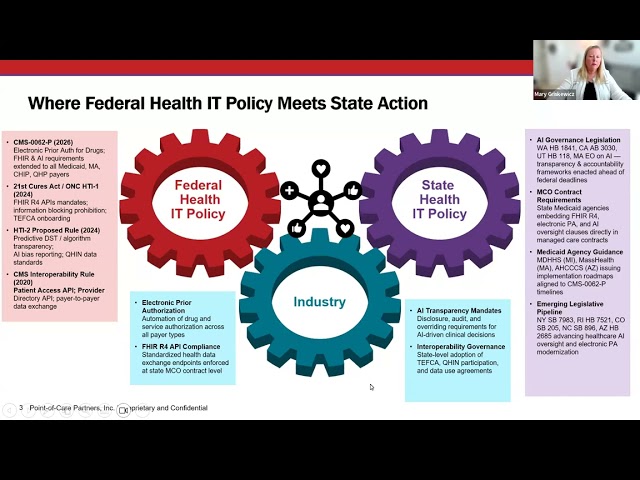
Federal vs. State Healthcare Policy: Why Both Matter for Interoperability, AI & Prior Authorization
Healthcare policy doesn't stop at the federal level. Understanding how federal and state healthcare policy interact is essential for organizations navigating interoperability, electronic prior authorization (ePA), FHIR, AI governance, advanced pharmacy practice, and other emerging health IT requirements.
In this webinar, Point-of-Care Partners (POCP) explores the federal-state policy cycle and explains how healthcare organizations can move beyond simply tracking regulations to making more informed strategic decisions.
You'll learn:
• How federal regulations and state policy influence one another
• Why organizations need to monitor both federal and state healthcare policy
• The impact of CMS-0057 and the proposed CMS-0062 rule on electronic prior authorization
• How states are shaping AI governance, transparency, and healthcare regulation
• Why advanced pharmacy practice is evolving differently across states and what that means for pharmacies, health systems, payers, and technology vendors
• How policy trends influence interoperability, reimbursement, product strategy, and care delivery
• Practical approaches for turning regulatory compliance into strategic advantage
This session includes real-world examples covering:
Healthcare interoperability
FHIR implementation
Electronic Prior Authorization (ePA)
CMS-0057 Final Rule
CMS-0062 Proposed Rule
Advanced Pharmacy Practice
Pharmacist Scope of Practice
AI Governance
Healthcare Artificial Intelligence
State Healthcare Legislation
Federal Healthcare Regulation
Healthcare Compliance
Health IT Strategy
Regulatory Intelligence
Healthcare Policy Monitoring
Whether you're with a health plan, health system, pharmacy, life sciences company, health IT vendor, or government agency, this webinar will help you better understand how policy developments across multiple levels of government can impact strategy, operations, technology investments, and compliance planning.
Learn more about Point-of-Care Partners: https://www.pocp.com
Explore our Regulatory Resource Center solutions: https://www.pocp.com/our-regulatory-resource-center/
Connect with us on LinkedIn: https://www.linkedin.com/company/point-of-care-partners
#HealthcarePolicy #HealthIT #Interoperability #FHIR #ElectronicPriorAuthorization #PriorAuthorization #CMS0057 #CMS0062 #AIGovernance #HealthcareAI #AdvancedPharmacyPractice #Pharmacy #HealthcareCompliance #HealthcareStrategy #HealthTech #RegulatoryAffairs #HealthcareInnovation -

The Dish on Health IT Podcast: Beyond Compliance: How Standards Communities Shape Health IT Policy
In this episode of The Dish on Health IT, Tony Schueth, CEO of Point-of-Care Partners (POCP), welcomes Pooja Babbrah, Executive Vice President of Strategy and Industry Alignment at NCPDP, and Anna Taylor, Associate Vice President of Population Health and Value-Based Care at MultiCare Health System and Steering Committee member of the HL7 Da Vinci Project, for a discussion on the relationship between standards development and policymaking. -

CMS 0062P Webinar = Held on May 7, 2026
This expert panel discussion covers what the proposed Interoperability and drug prior authorization rule (CMS-0062P) and gives listeners some food for thought on what to consider when crafting comments submission. -

Interoperability as Infrastructure: Policy, Prior Authorization, and the Path Forward with ONC
In this episode of The Dish on Health IT, Tony Schueth is joined by Dr. Thomas Keane, National Coordinator for Health IT at ONC, along with Alix Goss and Janice Reese. The conversation moves between policy, standards, and real-world implementation, with Tony often grounding the discussion in the practical friction points the industry continues to face. -

HIMSS26 Recap & Highlights: Here's What You Missed
In this HIMSS26 recap episode, host Tony Schueth is joined by Brian Bamberger, Vanessa Candelora, and Brian Dwyer to unpack what they heard, saw, and debated after a week on the ground in Las Vegas. Rather than focusing on announcements or product launches, the conversation centers on the signals emerging across sessions, client meetings, and hallway conversations, and what those signals suggest about where health IT is headed.


